aul goes to the Clippers — that sentence landed like a depth charge in July 2011. The Lakers had just been swept out of the playoffs, the Clippers were a punchline with Donald Sterling at the helm, and Chris Paul was a 26-year-old point god demanding a trade from New Orleans. I remember the initial reaction: confusion, then a slow dawning realization that the league's most cursed franchise had just landed a top-five player. The deal itself was a heist — Eric Gordon, Chris Kaman。Al-Farouq Aminu, and a unprotected first-round pick for a superstar. But the real story wasn't the trade package. It was what Paul's arrival did to the Clippers' self-concept.Before Paul goes to the Clippers, the team's identity was built on losing. Blake Griffin was a human highlight reel, sure, but the Clippers were still the team that drafted Michael Olowokandi, the team that let Baron Davis eat himself out of shape, the team whose owner was sued for housing discrimination. Paul changed the gravity. He didn't just run pick-and-rolls;
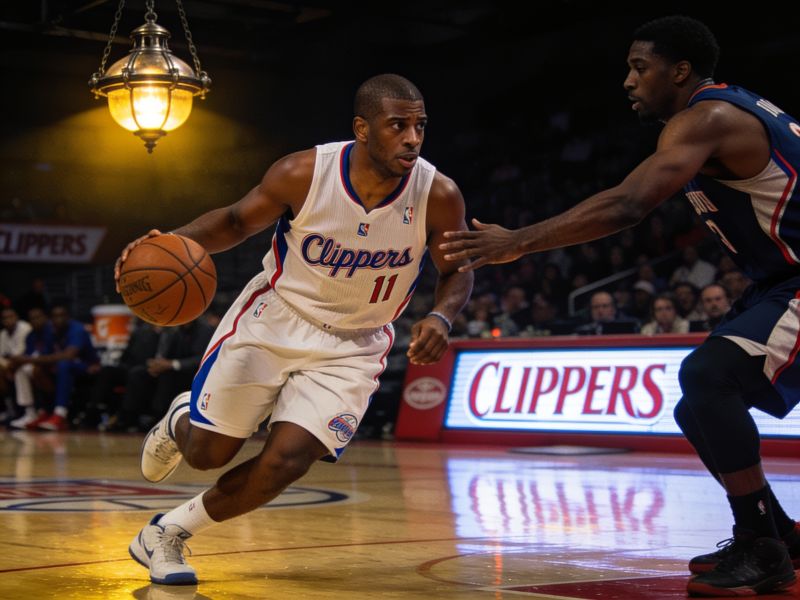
he ran the locker room. I watched him in his first preseason game — a nothing exhibition against the Lakers — and he was already barking at DeAndre Jordan about defensive rotations。grabbing Griffin by the jersey to point out a weakside cut. That kind of leadership was alien to a franchise that had spent decades accepting mediocrity. The Clippers won 40 games in a lockout-shortened season, then 56 the next year. Lob City was born, but the real shift was cultural: Paul made the Clippers expect to win.The on-court mechanics were ruthless. Paul's mid-range pull-up became the team's pressure release valve。and his pocket passes to Jordan turned a raw athlete into an All-NBA center. But here's what the highlight reels miss: Paul's obsessive control sometimes strangled the offense. I covered a game in Memphis in 2013 where he dribbled the air out of the ball for 22 seconds, then hoisted a contested fadeaway. The Clippers lost by four. He finished with 14 assists, but the rhythm was off — too much Paul, not enough flow. That tension defined the era. Paul goes to the Clippers and immediately raises the floor, but his need to micromanage every possession also capped the ceiling. They never made the conference finals, blowing a 3-1 lead to Houston in 2015 in a collapse that still feels surreal. Paul was brilliant in Game 6, then invisible in Game 7. The franchise's curse didn't vanish;it just wore a different mask.
What strikes me most, looking back, is how Paul's Clippers tenure prefigured the modern player-empowerment era. He forced his way to Los Angeles, then recruited Doc Rivers as coach, then helped lure shooters like J.J. Redick and Jared Dudley. That's standard operating procedure now。but in 2011 it was radical — a point guard acting as de facto general manager. Paul goes to the Clippers and the team becomes a destination, not a punishment. Free agents started taking meetings. Season-ticket sales jumped 30 percent in one year. The atmosphere at Staples Center shifted from ironic to electric. Even the purple-and-gold faithful started glancing over at the other locker room. That's the thing about Paul: he didn't just change the roster. He changed the air pressure around the organization.Six years, five All-Star appearances, zero conference finals. The ledger says Paul's Clippers run fell short. The eye test says otherwise. He dragged a laughingstock into relevance, then handed the keys to a new owner (Steve Ballmer) who actually invested in the product. When Paul left for Houston in 2017, he did so via sign-and-trade, leaving the Clippers with Lou Williams, Patrick Beverley, and a future MVP in Shai Gilgeous-Alexander. That's not a coincidence. Paul goes to the Clippers as a savior, leaves as a catalyst for the next rebuild. The franchise that once traded away first-round picks like candy suddenly had assets. I'm not saying he's a saint — the Clippers' playoff failures were partly his fault, the obsessive control。
the late-game cramps, the passive-aggressive comments about teammates. But the man walked into a carnival and left behind a basketball team. That's worth more than a banner.